

































India Assumes BRICS Presidency for 2026, Pledges Stronger Voice for Global South
India takes over the BRICS presidency for 2026, aiming to boost Global South influence, strengthen multilateralism, and push reforms amid rising global trade tensions.

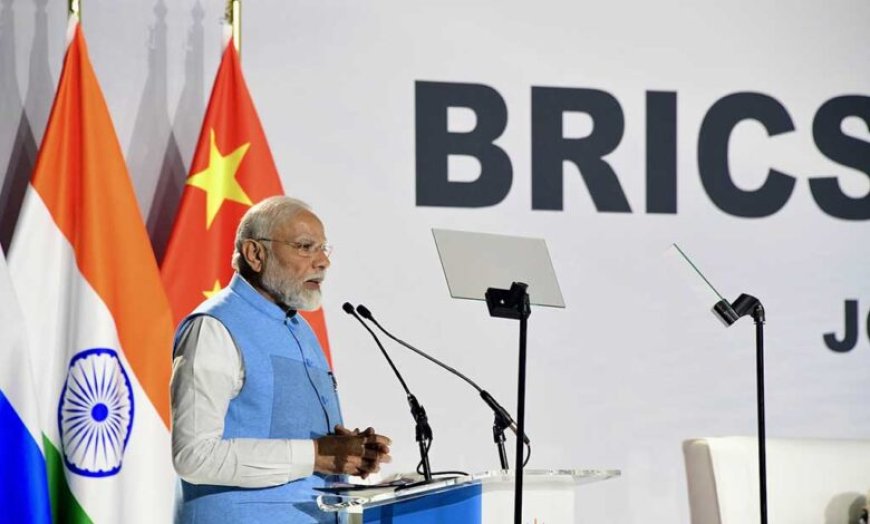
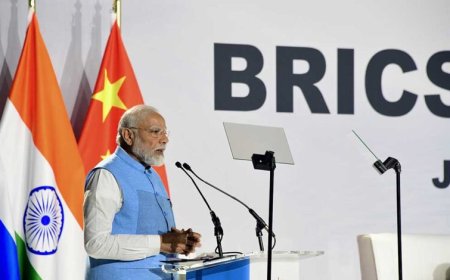
India on Thursday officially took over the rotating presidency of the BRICS bloc for 2026, positioning itself to champion inclusive development, reinforce multilateralism, and amplify the concerns of the Global South at a time of growing global trade disruptions triggered by aggressive US tariff policies.
The BRICS grouping, originally comprising Brazil, Russia, India, China, and South Africa, has expanded in recent years to include Egypt, Ethiopia, Indonesia, Iran, and the United Arab Emirates. While the BRICS website lists Saudi Arabia as the 11th member, its formal participation is yet to be fully confirmed.
As per World Bank data, the expanded BRICS bloc represents nearly 49% of the global population, about 29% of global GDP, and roughly 23% of international trade, highlighting its increasing influence in the global economic order.
India’s presidency comes amid heightened trade tensions with the United States. In August, US President Donald Trumpimposed tariffs of up to 50% on Indian exports, including an additional 25% penalty linked to India’s purchases of Russian oil. These were the steepest duties imposed on any US trading partner, matching those levied on Brazil during its BRICS presidency in 2025. Some of the additional tariffs on Brazilian food exports were later rolled back.
Earlier this year, Trump also warned BRICS nations against pursuing a common currency, declaring the bloc “dead” and threatening 100% tariffs if members attempted to undermine the dominance of the US dollar.
Experts believe India will adopt a measured approach during its BRICS leadership. According to Prerna Gandhi, Associate Fellow at the Vivekananda International Foundation, India is expected to avoid aggressive de-dollarisation and instead promote local currency settlements to preserve strategic autonomy while reducing exposure to external shocks.
India is also likely to push for reforms in global institutions such as the World Trade Organization (WTO) and the International Monetary Fund (IMF), while encouraging dialogue to reduce fragmentation and stabilise global supply chains.
Raj Kumar Sharma, Senior Research Fellow at NatStrat, said India would use its BRICS presidency to defend and strengthen multilateralism, particularly at a time when protectionism and unilateral trade actions are on the rise. He added that India would support reforms in global governance bodies including the United Nations Security Council, World Bank, and IMF, while advocating fairer trade rules and special treatment for developing economies.
On the Global South agenda, Sharma noted that India would build on the approach it adopted during its G20 presidency in 2023, prioritising human welfare, inclusive growth, food and fuel security, debt relief, and climate finance. He cautioned that these priorities may face challenges during the US-led G20 presidency, where Global South concerns may receive less emphasis.
Meanwhile, Pakistan, facing economic stress, has expressed interest in joining the BRICS-backed New Development Bank (NDB) to diversify its financing sources. Islamabad had applied for BRICS membership in 2023, reportedly seeking backing from Russia and China.
Analysts say India is likely to insist on clear, transparent criteria for BRICS expansion to ensure the bloc’s effectiveness is not diluted. While New Delhi supports expansion in principle, it has stressed that new members must strengthen BRICS as a platform for development cooperation and global governance reform, with decisions taken strictly through full consensus.
What's Your Reaction?
 Like
0
Like
0
 Dislike
0
Dislike
0
 Love
0
Love
0
 Funny
0
Funny
0
 Angry
0
Angry
0
 Sad
0
Sad
0
 Wow
0
Wow
0